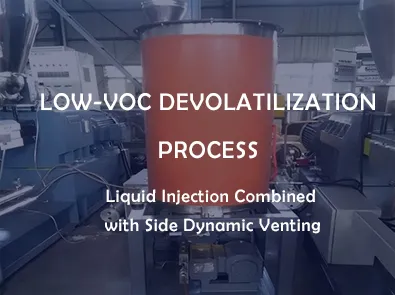



Liquid Injection Combined with Side Dynamic Venting
In graft modification and reactive extrusion processes, volatile by-products and residual monomers are often the key factors affecting material odor, VOC levels, and downstream processing stability. Systems such as maleic anhydride grafting place particularly high demands on devolatilization efficiency and process reliability.
To address these challenges, a low-VOC devolatilization solution based on liquid injection combined with side dynamic venting has been developed, enabling effective removal of residual volatiles while maintaining stable reaction performance.
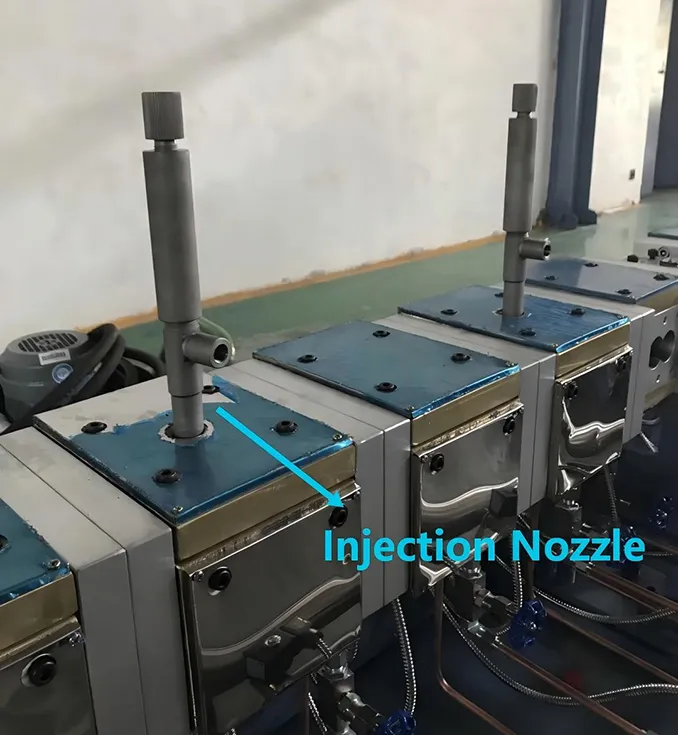
During extrusion, water—or entrainers such as alcohol or acetone (with appropriate explosion-proof design)—is injected into the melt through a high-pressure liquid injection system (≥10 MPa) via a dedicated injection nozzle (atomizing spray nozzle). The injected liquid is finely dispersed into the melt and rapidly vaporizes under high-temperature conditions, forming an azeotropic system with residual monomers and low-molecular-weight volatiles, thereby significantly enhancing devolatilization efficiency. The injection rate can be flexibly adjusted according to formulation and process requirements, typically in the range of 10–20%, with maleic anhydride grafting processes commonly operating around 20%.

The generated vapor and entrained volatiles are continuously discharged through a side dynamic venting system, exiting via the dynamic clearance between the screw and barrel. Compared with conventional static vacuum venting, this design minimizes melt disturbance and provides a more stable venting window, ensuring controlled and continuous devolatilization even under high-fill and high-reaction-load conditions.

This low-VOC process is particularly suitable for compounding and reactive extrusion applications that must balance reaction efficiency, odor control, and long-term operational stability, and has become a proven technical approach for demanding grafting systems.